


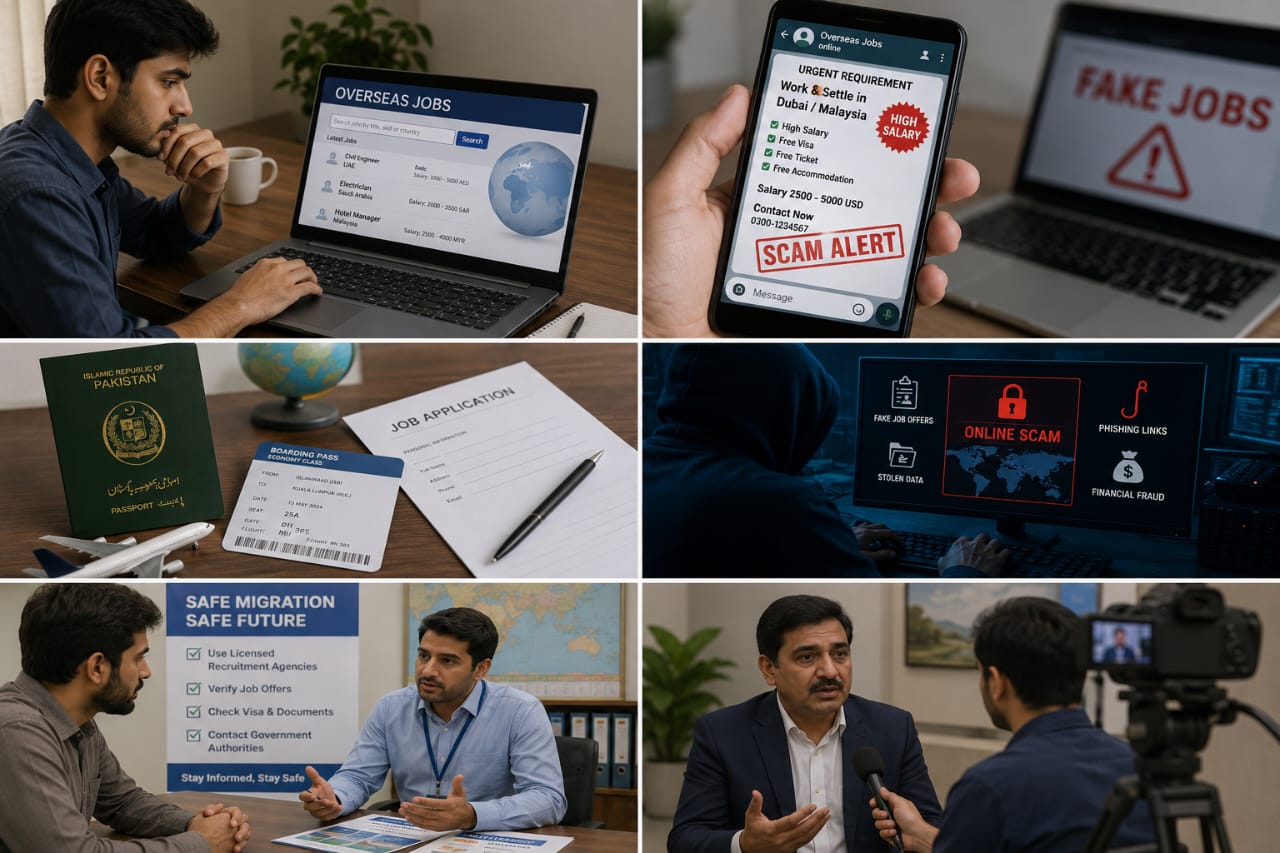
Every year, thousands of young Pakistanis dream of building a better future abroad. For many, overseas employment represents an opportunity to escape unemployment, support their families, and achieve financial stability. While legal migration has transformed countless lives, the growing use of social media and encrypted messaging apps has also created new opportunities for criminal networks to exploit vulnerable job seekers through deceptive recruitment schemes.

In recent years, reports from governments, international organizations, and human rights groups have highlighted how people from South Asia have been lured to countries in Southeast Asia with promises of well-paid jobs. Instead of legitimate employment, some victims have found themselves trapped in compounds where they are forced to participate in online scams targeting people around the world. Many have reported having their passports confiscated, facing threats, and being unable to leave without paying large sums of money.

Although Pakistan is not among the countries with the highest number of identified victims, authorities have acknowledged cases in which Pakistani citizens were deceived through fake overseas job advertisements. These incidents demonstrate that online recruitment fraud is becoming increasingly sophisticated and difficult to detect.
The problem often begins with a simple advertisement on Facebook, WhatsApp, Telegram, or another social media platform. Attractive salaries, free accommodation, visa assistance, and promises of quick departures are designed to appeal to young people struggling to find employment at home. Some recruiters even use fake company logos, forged documents, and fabricated testimonials to appear trustworthy.
For many applicants, the pressure to earn an income outweighs the need to verify whether an offer is genuine. Families may sell land, borrow money, or take loans to finance overseas travel, believing they are investing in a brighter future. When the job turns out to be fraudulent, the financial and emotional consequences can be devastating.
The rise of digital technology has fundamentally changed the way recruitment scams operate. Criminal groups no longer rely solely on informal agents working in local communities. Instead, they can reach thousands of potential victims within minutes through targeted advertisements, social media groups, and messaging applications. Artificial intelligence, manipulated images, and fake websites have made it easier than ever to create convincing online identities.

For journalists, these developments present both a challenge and a responsibility. Reporting on migration should go beyond statistics and sensational headlines. Stories should focus on the human experiences behind the numbers while avoiding language that stigmatizes migrants or blames victims for being deceived.
Victims of scam trafficking are not criminals simply because they were forced into illegal online activities. Many were manipulated, threatened, or coerced after accepting what they believed to be legitimate employment. Human rights principles require that their dignity, privacy, and safety remain central to media coverage.

Responsible reporting also means carefully verifying information before publication. Images circulating on social media, dramatic claims, and viral videos may not always reflect reality. In an era of misinformation, journalists must rely on credible sources, official records, and independent verification instead of amplifying unconfirmed narratives.
Pakistan's media can play an important role in preventing exploitation by raising public awareness about safe migration practices. Reporting should explain how prospective migrants can verify overseas employment opportunities, use licensed recruitment agencies, and seek information from relevant government institutions before accepting offers. Awareness campaigns can be particularly valuable for young people in communities where overseas employment is viewed as the primary path to economic security.

At the same time, public discourse should recognize that migration itself is neither illegal nor inherently dangerous. Millions of people migrate safely every year through legal channels. The real threat comes from criminal networks that exploit people's hopes, economic hardship, and lack of reliable information.
International cooperation is equally important. Scam trafficking networks often operate across several countries, making investigations complex and requiring collaboration between law enforcement agencies, technology companies, governments, and civil society organizations. Journalists can contribute by reporting responsibly, exposing patterns of exploitation, and highlighting policies that strengthen protection for migrants without spreading fear or misinformation.
For Pakistan, improving digital literacy is becoming just as important as improving migration governance. Young people need practical skills to identify fraudulent recruitment offers, verify online information, and recognize warning signs before making life-changing decisions. Educational institutions, media organizations, and public agencies all have a role to play in building this awareness.
Behind every migration story is a person searching for opportunity, security, and dignity. When that hope is manipulated by criminal networks, the consequences extend far beyond financial loss. Families are separated, communities suffer, and trust is eroded.

Journalists have the power to shape public understanding of these complex issues. By reporting with accuracy, empathy, and respect for human rights, the media can help expose exploitation without reinforcing harmful stereotypes. In doing so, journalism becomes more than a record of events—it becomes a tool for prevention, accountability, and informed public dialogue.
.jpeg)





1 Comments
hi!,I like yohr writing very a lot! percenmtage wwe
keep up a correspondence exta aproximately yoir post on AOL?
I need an expert on this space to unrasvel my problem.
Maay be tha is you! Looking forward to look you. xnxx
Herre is my blog post ... webpage (<a href="https://tr.yeni-porn.com/">https://tr.yeni-porn.com/</a>)