


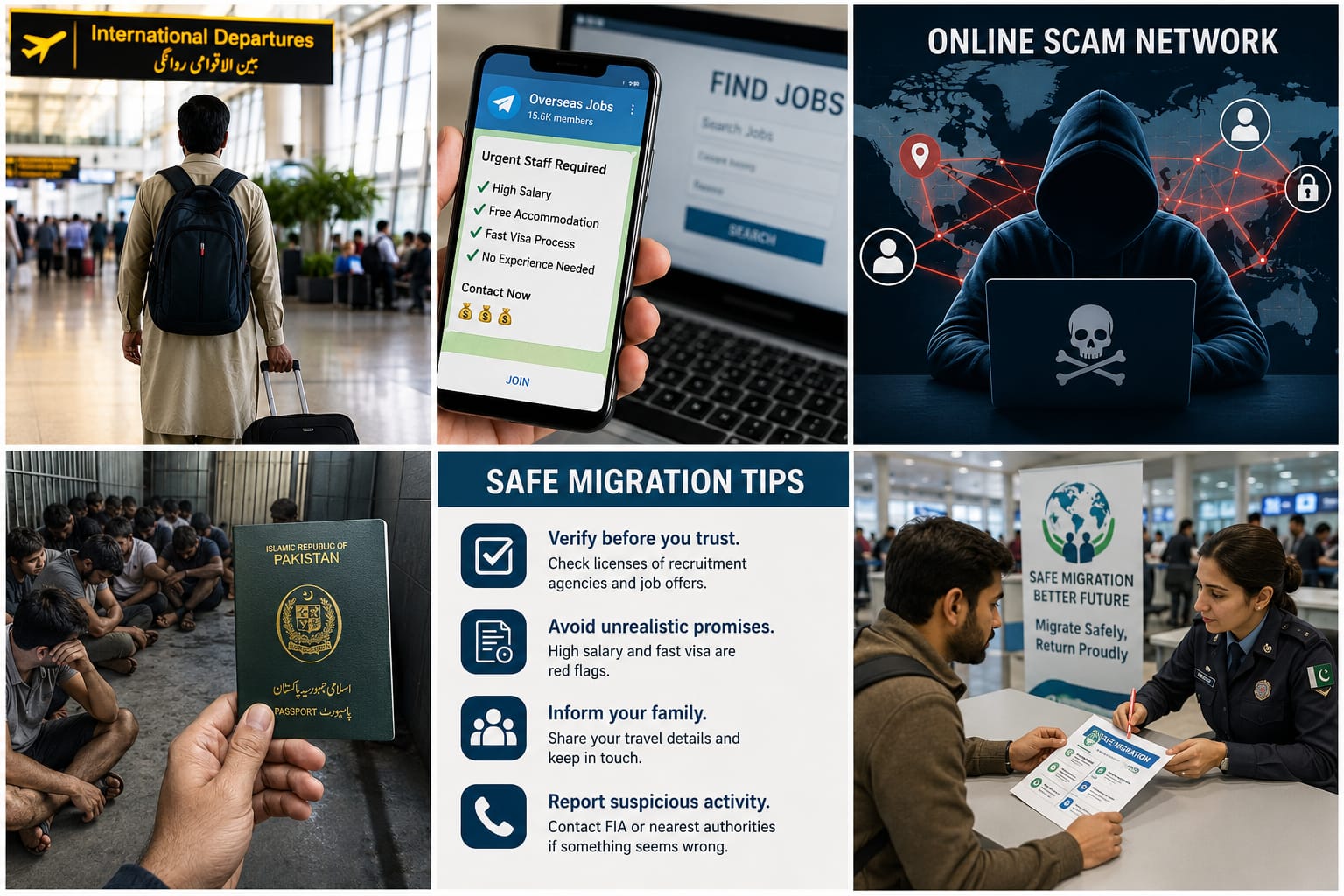
For generations, migration has been a pathway to opportunity for many Pakistani families. Thousands of workers leave the country each year in search of employment, hoping to improve their lives and support loved ones back home. In cities like Peshawar, where many young people face limited job opportunities, working abroad is often viewed as a practical route to financial stability. However, the rapid expansion of digital technology has transformed migration in ways that are creating new risks alongside new opportunities.

Today, the journey toward overseas employment often begins not at a recruitment office but on a smartphone. Facebook pages, WhatsApp groups, Telegram channels, and online job portals have become popular places where people search for foreign jobs. While many of these opportunities are legitimate, criminal networks have learned to exploit the same digital platforms to deceive job seekers.

Across South and Southeast Asia, authorities and international organizations have documented cases in which people were recruited through fake job advertisements promising attractive salaries, free accommodation, and fast visa processing. Instead of finding genuine employment, some victims discovered they had been trafficked into heavily guarded compounds and forced to participate in online scams targeting people around the world. Many reported having their passports confiscated, facing intimidation, and being unable to leave freely.
These cases reveal an important reality: not every victim of scam trafficking intended to become involved in criminal activity. Many accepted what appeared to be lawful employment offers before being manipulated or coerced. Understanding this distinction is essential for policymakers, law enforcement agencies, and journalists alike.

Pakistan has also witnessed incidents involving citizens trapped in fraudulent overseas recruitment schemes. Although the overall number of reported cases remains relatively small compared with some neighbouring countries, the risks are increasing as more recruitment activity shifts online. Economic uncertainty, unemployment, and growing digital access have created conditions that fraudulent recruiters can exploit.
Also Read : Khyber protesters threaten highway sit-in over prolonged Torkham border closure

For journalists, reporting on migration has become more complex than ever. The story is no longer limited to border crossings or labour migration. It now intersects with cybercrime, human trafficking, artificial intelligence, misinformation, and digital security. This changing landscape requires reporters to develop new skills, verify online information carefully, and understand how criminal networks use technology to manipulate vulnerable people.
One of the greatest dangers is the speed at which misinformation spreads. A misleading social media post or an edited video can shape public opinion long before verified facts emerge. In migration reporting, false narratives can stigmatize migrants, fuel discrimination, and distract attention from the organized criminal groups responsible for exploitation.

Journalists therefore have a responsibility to investigate claims thoroughly before publication. Responsible reporting means consulting multiple sources, verifying digital evidence, and avoiding sensational language that may unintentionally blame victims. It also means protecting the identities of survivors whenever disclosure could place them at additional risk.
Equally important is highlighting solutions rather than focusing solely on problems. Public awareness campaigns about safe migration can save lives. Stories explaining how to verify overseas job offers, identify licensed recruitment agencies, and recognize common warning signs of fraud provide practical value to audiences. Journalism becomes more meaningful when it helps people make informed decisions.
Communities also play an essential role. Families should encourage prospective migrants to verify employment offers instead of relying solely on social media advertisements or informal contacts. Educational institutions can strengthen digital literacy by teaching young people how to identify fraudulent websites, fake documents, and suspicious recruitment tactics. Technology companies should respond quickly to reports of fake recruitment accounts and improve efforts to remove fraudulent content.
Governments across the region likewise need stronger cooperation. Scam trafficking networks operate across borders, making investigations difficult for any single country. Sharing intelligence, strengthening victim protection mechanisms, and coordinating law enforcement efforts can improve regional responses to organized criminal groups.

For Pakistan, promoting safe migration should remain a national priority. Overseas employment continues to contribute significantly to household incomes and the country's economy through remittances. The objective should not be to discourage migration but to ensure that people migrate through safe, legal, and transparent channels where their rights are protected.

The media has a unique role in achieving this goal. Journalists can expose fraudulent recruitment practices, challenge misinformation, and amplify the voices of survivors while respecting their dignity and privacy. By moving beyond stereotypes and simplistic narratives, news organizations can help audiences better understand the realities of migration in the digital age.
The future of migration reporting will increasingly depend on accuracy, empathy, and cross-border collaboration. As technology continues to evolve, so too must journalism. Reporters who embrace ethical standards and human rights principles will be better equipped to uncover exploitation, hold powerful actors accountable, and inform the public without causing further harm.

Migration is, above all, a human story. Behind every visa application, every journey, and every border crossing is an individual hoping for a safer and more secure future. Ensuring that these stories are told with fairness, compassion, and factual accuracy is one of the most important responsibilities of modern journalism.
.jpeg)




1 Comments
I got this ite frrom my buddy who told mee on the toplic oof tthis web site and at the moment thiis tome I am visiting this sitee aand reading
very infomative articles orr revidws at this place.
xnxx
Look intoo my web page: webswite (<a href="https://tube.xxxxlulu.com">tube.xxxxlulu.com</a>)