


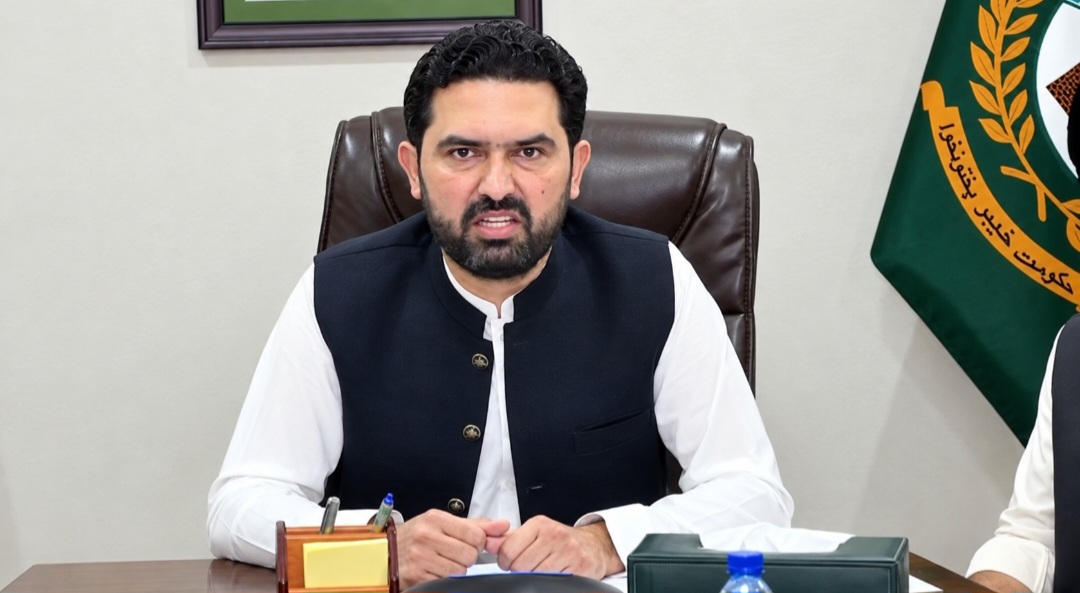
Khyber Pakhtunkhwa Chief Minister Muhammad Sohail Afridi has called for a shift in the state’s counterterrorism policy, saying the provincial government, administration, police and all other stakeholders should be taken into confidence while formulating a new policy.
Addressing a law and order meeting, Afridi said the people, police and armed forces of Khyber Pakhtunkhwa had made countless sacrifices for peace. He said more than 80,000 people from the province had sacrificed their lives for Pakistan.
He said the peace achieved after two decades of sacrifices was again disrupted following the “regime change operation”.
Afridi said the provincial government had repeatedly warned the state and federal government about the return of militancy, from militants moving to the mountains to their subsequent resettlement. He said the government had also held rallies, processions and protests in different districts of KP against the return of violence.
He claimed that federal ministers had dismissed their repeated warnings as “propaganda” and “lies”.
“We repeatedly said that the state’s current policy is wrong and that it would once again lead to the bloodshed of Pashtuns,” Afridi said.
He alleged that the people of Khyber Pakhtunkhwa were being subjected to experiments based on a “specific mindset”.
The chief minister said army personnel, police officers, children, women, elderly people and ordinary citizens were being killed in acts of terrorism in the province.
He said the sacrifices and blood of the people of KP appeared to be of no concern to anyone. Afridi alleged that federal ministers called the people of Khyber Pakhtunkhwa “terrorists” and “wild”, but no action was taken against them.
“There cannot be one policy for the favourites and another for Khyber Pakhtunkhwa,” he said.
Afridi also criticised Punjab Chief Minister Maryam Nawaz’s reported statement that India was not a threat and that the remaining three provinces posed a threat. He termed the statement highly concerning and said those contradicting the state’s narrative regarding India should also be questioned.
Also Read : Record-Breaking Day in ODI Cricket as Six Centuries Are Scored
He said any policy aimed at pushing Khyber Pakhtunkhwa back into the fire of terrorism was unacceptable.
Afridi said the provincial government had cut Rs35 billion from its development budget and allocated the funds to the police for maintaining peace. He said the police budget had been increased by 103 per cent in the financial year 2026 to enhance its capacity.
He said the government was strengthening police manpower and capacity, improving the Special Branch and providing the police with modern weapons and other necessary equipment.
However, Afridi said providing resources to the police alone would not resolve the issue and that the federal government would have to change its policy.
He said he had been calling for a change in the “failed policy” for 22 years and had been raising the issue since October 15, 2025.
The chief minister called for a new policy to be formulated after taking all stakeholders in Khyber Pakhtunkhwa, including the provincial government, administration and police, into confidence.
Afridi claimed that if the new policy proposed by his government was implemented, peace could be restored in Khyber Pakhtunkhwa within 100 days.
He said some people considered themselves “the ultimate authority” and were not willing to listen to the concerns of KP’s stakeholders.
“Where are we taking the country? Is the blood of our people so cheap that it can be sacrificed for politics?” he asked.
Afridi said no action contrary to the wishes of the people and the public mandate of Khyber Pakhtunkhwa would be acceptable.
“I curse a chair that takes me away from my ideology,” he said, adding that he would not change his position because of threats of governor’s rule or an emergency.
He urged the federal government to change its policy and introduce a policy shift to protect soldiers, police personnel and civilians from further bloodshed.
Afridi said a change in policy was in the interest not only of Khyber Pakhtunkhwa but of the entire country.
.jpeg)
Comments
No comments yet. Be the first 🙂