


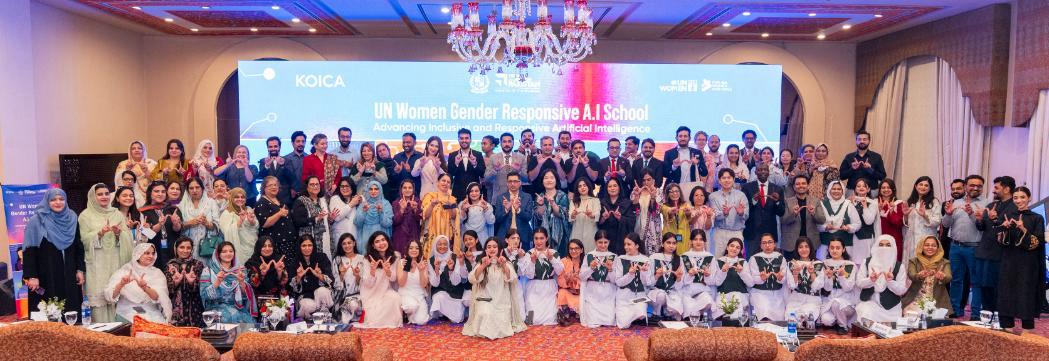
Islamabad: The Ministry of Information Technology and Telecommunication (MoITT), in collaboration with UN Women Pakistan and with support from the Korea International Cooperation Agency (KOICA), has launched the UN Women Gender-Responsive AI School Pakistan, marking a significant step towards promoting inclusive, ethical and gender-responsive artificial intelligence (AI) in the country.
The initiative aims to strengthen national capacity by equipping policymakers, government institutions, parliamentarians, the United Nations system, academia, civil society, the private sector and community leaders with the knowledge and practical skills to use AI responsibly while ensuring the equal participation of women and girls in Pakistan's digital transformation.
Speaking at the launch ceremony, UN Women Pakistan Country Representative Jamshed M. Kazi said Pakistan was setting a new benchmark for the Asia-Pacific region by becoming the first country in South Asia to host the full national Training of Trainers (ToT) track of the UN Women AI School. He said the initiative would help build leadership, institutions and skills needed for an inclusive, ethical and gender-responsive AI future.
The curriculum combines conceptual learning with practical application through tailored learning pathways covering AI foundations, gender-responsive and ethical AI, AI governance, prompt engineering, AI agents, and AI applications for public administration and inclusive development. Prior to the launch, specialized training programmes were conducted for parliamentarians, government officials, UN personnel, academia and civil society to create a national network of AI champions.
Also Read : Border Chambers Unite to Push for Reopening of Pakistan-Afghanistan Crossings
KOICA Pakistan Deputy Country Director Sodam Baek said the agency was proud to support the initiative as an investment in Pakistan's inclusive digital future by strengthening digital skills and promoting responsible AI to create equal opportunities for women and girls.
According to UN Women, only around two dozen of nearly 140 national AI policies worldwide make reference to gender. The AI School aligns with the Global Digital Compact, the CSW67 Agreed Conclusions and the Beijing+30 agenda by integrating gender equality, ethics and inclusion into AI policy, governance and innovation.
During the ceremony, MoITT and UN Women Pakistan signed a Memorandum of Understanding (MoU) to institutionalize the AI School, followed by its symbolic handover to the Ministry to reinforce national ownership and long-term sustainability.
Federal Minister for Information Technology and Telecommunication Shaza Fatima Khawaja said artificial intelligence was transforming every sector of society and Pakistan was committed to ensuring the transformation remained inclusive and responsive. She said the partnership with UN Women and KOICA would strengthen institutional capacity, advance ethical AI governance and create opportunities for women and girls in the digital economy.
Pakistan has become the first country in South Asia to host the full national Training of Trainers track of the UN Women AI School. Since 2024, the regional initiative has trained more than 5,000 policymakers, UN personnel, civil society leaders and young innovators across Asia and the Pacific.
The event also featured presentations on the outcomes of the Training of Trainers programme, highlighting practical applications of AI in governance, parliamentary research, education and community engagement.
The initiative supports Pakistan's digital transformation agenda and contributes to achieving the Sustainable Development Goals, particularly SDG 5 on Gender Equality and SDG 9 on Industry, Innovation and Infrastructure. MoITT, UN Women and KOICA will continue working with development partners, academia, civil society and the private sector to promote AI for equality, innovation and sustainable development.
.jpg)

.jpeg)
.jpeg)
Comments
No comments yet. Be the first 🙂