


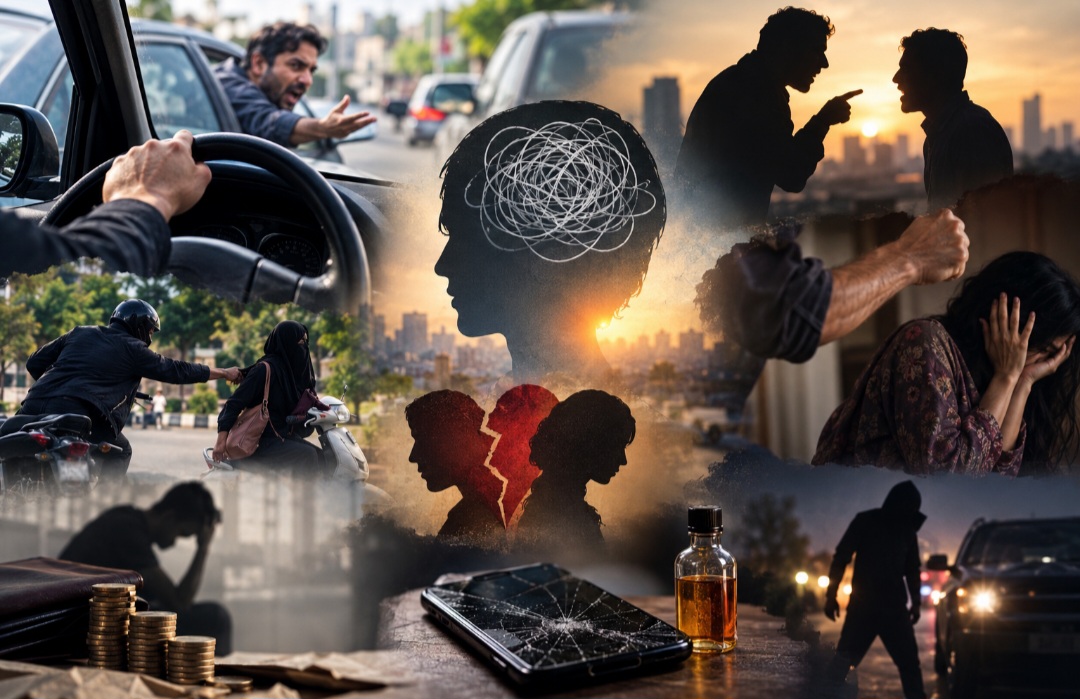
A bitter remark, a minor disagreement or a few moments of ego can lead to consequences that can never be undone. Several recent incidents in Pakistan have raised an important question: Has anger and frustration increased so much in society that even minor disputes are turning into acts of violence?
Imagine you are driving on the road when someone behind you honks. You do not give way, or you disagree with another person over something. Such situations should be resolved within moments. However, if they lead to verbal abuse, threats, pursuit or physical violence, the issue is no longer just a dispute between two individuals. It raises serious questions about our social attitudes and behaviour.
Why do we turn minor issues into matters of personal ego? Where are we losing our ability to listen to others, tolerate differences and control our anger?

Several incidents reported across Pakistan in October 2026 have raised questions about growing intolerance in society. In Multan, 15-year-old orphan Waseem Abbas was allegedly run over and killed by his employer after leaving his workplace. According to police, the boy was leaving his job when the suspect chased him in a vehicle before running him over.

In Karachi's Gulshan-e-Iqbal area, a dispute following a minor collision between two cars led to gunfire, injuring a labourer who was not even involved in the argument.
In Thatta, a 14-year-old boy was accused of killing his 58-year-old father over a dispute involving a mobile phone. However, the victim's brother also accused rival individuals of being involved in the incident. The investigation is ongoing.
Meanwhile, on Lahore's Mozang Link Road, a motorcyclist assaulted a woman riding a scooter following a minor traffic dispute. Although the circumstances of these incidents were different, each highlights the need to reflect on the serious consequences of anger and conflict.
This problem is not limited to roads or homes. Inflation, unemployment, economic uncertainty, family pressures, worries about the future and constant mental exhaustion also affect people's lives.
Sometimes, even a minor issue can trigger an intense reaction. However, economic or psychological stress does not justify violence against another person. The question is: Why do we turn disagreements into battles of ego instead of resolving them through dialogue?
My own experience as a journalist also highlights another aspect of this situation. In 2024, when I was only in the first year of my journalism career, I tried to prepare a report on the denial of women's inheritance rights in Swat. During the reporting process, a man began pressuring me. He repeatedly threatened that if I published the report, he would show me how much acceptance I had in society.

He also threatened to abduct me for a few days and keep me away from home, saying that afterwards he would see what my standing was within my family and society. He even sent me a picture of a bottle of acid and, in a threatening tone, said it was meant to put women like me on the right path.
I have always tried to ensure that the purpose of my journalism is not to fuel conflicts but to highlight issues and create opportunities for solutions. However, this incident made the situation extremely difficult for me. For my safety, my family banned me from using all my social media accounts.

To this day, I do not have any social media accounts. For nearly six months, my mother accompanied me to university every day and brought me back home. She also faced objections from people because of the traditional social environment, but she never stopped supporting me. Due to this pressure, I had to suspend my journalistic work for nearly five months. For me, this was not just a threat; it was an experience early in my career that affected both my professional work and my family.
Also Read : Public Service Begins with Punctuality
Recently, a female friend of mine shared an incident from her journey from Islamabad to Swat. According to her, the bus driver repeatedly pressured a veiled woman to sit in the front seat, even though seats at the back were available. She said that when she supported the woman, the driver got off the bus and slapped her. Other passengers later intervened and stopped the situation from escalating.

Similarly, one of my classmates told me that after he honked at a vehicle parked in the middle of the road, a man began chasing his car. The man repeatedly drove ahead of and behind his vehicle, putting him at risk of an accident on three separate occasions.
In our society, treating disagreement or refusal as a personal insult creates fear and insecurity for others.
In this context, Pakistan's first nationwide mental health survey, published in the medical research journal BMJ Public Health in September 2026, holds particular significance.
The study examined 17,773 adults across all four provinces between 2019 and 2022. According to its findings, 32.3 per cent of participants met the criteria for a current diagnosis of a mental or behavioural disorder. The survey results showed that nearly one in every three adults fell into this category.
A study on aggressive behaviour, published in the Pakistan Social Sciences Review in June 2020, is also noteworthy. It included 374 university students from Pakistan and Australia, comprising 292 Pakistani and 82 Australian students.

According to the research, 86 per cent of Pakistani students showed moderate to high levels of aggression, compared with 41 per cent of Australian students. Researchers identified frustration as one of the major factors contributing to aggressive behaviour among students.
Psychological research has also examined the relationship between emotional intelligence and aggression. A study published in the Journal of Aggression, Maltreatment and Trauma in 2020 examined 100 students (50 men and 50 women) from the International Islamic University Islamabad and the National University of Modern Languages (NUML), Islamabad. The findings revealed a negative relationship between emotional intelligence and aggression.
A serious aspect of social intolerance is violence against women. According to Pakistan's 2017-18 Demographic and Health Survey, 42 per cent of married women and 40 per cent of married men considered a husband's violence against his wife justified in at least one situation.
These situations included arguing with the husband, going outside without informing him, neglecting the children, burning food and refusing marital relations. These figures highlight how deeply concerning the mindset is that considers disagreement a justification for violence.
According to data provided by the Ministry of Human Rights in the Pakistan Bureau of Statistics' 2026 Compendium of Gender Statistics, 55 acid attack incidents were reported in 2025, compared with 29 in 2024.
Psychological research emphasises the importance of emotional education, anger management skills, counselling and access to mental health services.
Sociologists believe that changes in education, family environments, economic conditions and attitudes that normalise violence are also necessary. The state and law enforcement agencies must take effective action against violence, threats and harassment arising from minor disputes.
The question, ultimately, is whether we are moving towards a society where refusing to give someone way, disagreeing with someone or simply saying no according to one's own choice is enough to hurt another person's ego.

Have we turned disagreement into hostility and anger into a means of imposing our will on others? If so, instead of pointing fingers at others' behaviour, we must also examine our homes, educational institutions, roads and the way we nurture social values.
A better society is not one where disagreements do not exist, but one where people know how to respect the dignity and lives of others despite their differences.
Note: This article is based on the author's personal opinion, which does not necessarily reflect the views of the organisation.




Comments
No comments yet. Be the first 🙂