


By Iman Zahir Shah
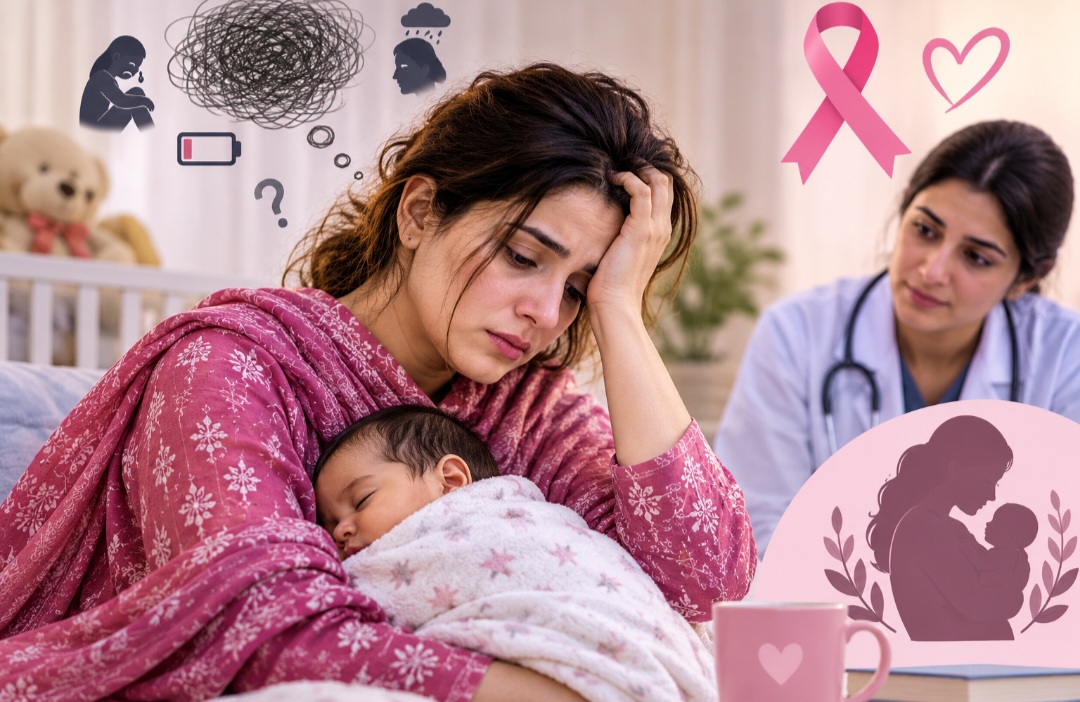
The birth of a child is considered one of the happiest moments in a mother's life. However, not every mother experiences this happiness in the same way. For some women, the period after childbirth can be marked by sadness, anxiety, fear and loneliness rather than joy. They may struggle to develop an emotional bond with their own child and sometimes begin to see themselves as bad mothers.
This condition is not merely a result of physical exhaustion. It could be postpartum depression, a treatable mental health condition.
Sadness and guilt instead of the joy of motherhood:
Talking to TNN, Maham Iqbal, who experienced postpartum depression, shared the emotional challenges she faced after childbirth and how the condition affected her life.
The 30-year-old resident of the village of Shidu in Nowshera district says she experienced postpartum depression after giving birth to her son. According to her, she would start crying over minor issues and become irritated over small things. At times, she would even feel angry with her own son, which left her further distressed and overwhelmed by guilt.

Maham says that during this period, she sometimes felt as though her son was the reason behind the suffering she was experiencing. She explains that when her baby cried, she sometimes did not even have the strength to comfort him or calm him down. Her in-laws would call her selfish and accuse her of not loving her son. Their attitude further deepened her sense of guilt.
Maham later consulted a gynaecologist, who explained that some women experience such emotional difficulties after childbirth. The doctor advised her to make time for herself, remain calm and allow herself enough time to recover from the condition. Maham says her condition gradually improved with time.
Symptoms of postpartum depression and its impact on mother-child bonding:
Speaking on the subject, Assistant Professor Dr Nazish Hayat of Lady Reading Hospital said postpartum depression is a mental health condition that can develop after childbirth. It can also severely affect the bond and emotional attachment between a mother and her child.

How do hormonal changes contribute to postpartum depression?
Speaking to TNN, Dr Nazish Hayat said postpartum depression is a relatively common condition, affecting more than 10 per cent of women after childbirth. However, its prevalence may vary across different populations.
She explained that after childbirth, levels of hormones such as oestrogen and progesterone drop rapidly in a woman's body, forcing it to adjust to sudden hormonal changes.
Oestrogen and progesterone are important hormones in the female body that play a significant role in maintaining various bodily changes during pregnancy. Their levels increase considerably during pregnancy. These major hormonal changes can affect some women's moods, emotions and mental well-being.

According to Dr Nazish Hayat, physical exhaustion, lack of sleep, the recovery process after childbirth, pain and difficulties with breastfeeding can also create additional challenges for new mothers and increase the risk of postpartum depression.
Which women are at greater risk of postpartum depression?
Dr Nazish says women who have previously experienced depression or another mental health condition, or have a family history of such illnesses, may be at greater risk of developing postpartum depression.
According to her, women who have experienced postpartum depression after a previous pregnancy have approximately a 25 per cent risk of experiencing it again.

Other risk factors include financial difficulties, marital or family problems, lack of social and family support, complications during pregnancy or childbirth, the birth of twins or multiple babies, sleep deprivation and prolonged psychological stress.
Symptoms of postpartum depression and how to recognise them:
According to Dr Nazish Hayat, common symptoms of postpartum depression include persistent sadness, hopelessness, frequent crying, loss of interest in everyday activities, extreme fatigue, changes in appetite and disturbed sleep patterns.
However, sleep disturbances associated with postpartum depression are different from the normal sleep deprivation that occurs due to caring for a newborn baby.

She further explained that difficulty developing an emotional bond with the baby, anxiety, nervousness, excessive worrying and trouble concentrating can also be symptoms of the condition. Thoughts of harming oneself or the baby are considered serious symptoms.
Diagnosis of postpartum depression, risk of recurrence and effects of delayed treatment:
Dr Nazish Hayat explained that postpartum depression can begin within the first few weeks after childbirth. However, women should also be screened for the condition three to four months after delivery. While some women develop symptoms immediately, others experience a gradual onset of the condition.
She said it is not necessary for a woman to experience depression after every pregnancy. Women who have previously suffered from postpartum depression can benefit from regular medical check-ups and follow-up care after childbirth.
Also Read : When Small Disagreements Turn Deadly: Is Pakistan Becoming an Intolerant Society?
Highlighting the effects of delayed treatment, she said that if the condition is not treated in time, its effects can persist for a long period. It can lead to prolonged depression or anxiety, difficulties in developing an emotional bond with the baby, marital and family problems, and a decline in overall quality of life.

Dr Nazish Hayat pointed out that a mother's poor mental health can also affect her child's emotional, behavioural and psychological development. It may also increase the risk of self-harm and suicidal thoughts in the mother.
Concluding her remarks, she emphasised that postpartum depression is a medical condition experienced by many mothers. Women who experience persistent sadness, psychological distress or helplessness and struggle to manage their daily activities should not hesitate to speak to a healthcare professional, family member or someone they trust.
Importance of timely support and treatment:
Dr Nazish Hayat said seeking help in time can make a significant difference. With appropriate support, understanding and treatment when needed, a mother can develop a healthy relationship with her child and family.
Postpartum depression: A mother's struggles:
Laraib Hussain, a 26-year-old resident of Swabi, says her behaviour and mental state changed significantly after the birth of her second daughter.
She became withdrawn and sometimes heard the sound of a baby crying in her ears. She says that whenever she sat alone in her room, she felt as though she could hear crying from all directions. During this period, she spoke very little and often responded only with a yes or no.

According to Laraib, she sometimes experienced thoughts of killing her baby girl. Instead of recognising her condition as a mental health issue, her family attributed it to the influence of jinn (supernatural beings). As a result, she faced difficulties in accessing timely medical or psychological support.
Four major psychological effects of postpartum depression:
Clinical psychologist Huma Kanwal, head of the Institute of Public Mental Health and Behavioural Sciences at Khyber Medical University in Peshawar, told TNN that postpartum depression does not simply make a mother feel sad. It also affects how she views herself, her child, her relationships and her future.

Sharing her observations from clinical practice with women in Khyber Pakhtunkhwa, Huma Kanwal said postpartum depression affects four major psychological dimensions simultaneously. These dimensions can intensify one another, potentially creating a harmful cycle.
Cognitive and psychological effects:
At the cognitive level, postpartum depression can affect a mother's thinking to such an extent that negative thoughts repeatedly enter her mind and she feels unable to control them.
She may constantly think: "I am not taking good care of my baby," "I am not capable of being a good mother," "There is something fundamentally wrong with me," or “My baby would be better off without me.”

These are not merely negative thoughts. Sometimes, they are intrusive thoughts that feel completely real to the mother, making it difficult for her to accept evidence that contradicts them.
Even when the baby is healthy and developing well, a mother experiencing depression may fail to recognise this as evidence of her ability to care for her child. This is because the condition continues to affect her thinking.
Emotional effects:
At the emotional level, postpartum depression is not limited to the sadness commonly associated with the condition.
During clinical practice, some mothers report being unable to feel love for their newborn babies. This situation can leave them feeling frightened, ashamed and deeply distressed.
Mothers often expect to experience a deep and unconditional love for their babies after childbirth, something repeatedly emphasised by society, families and traditional narratives about motherhood.

However, instead, they may feel emotionally numb, detached, frightened or irritable. Some mothers also experience intense anxiety that they find difficult even to put into words.
Some mothers cry continuously without even understanding why they are crying. For others, being unable to feel any emotions is even more frightening. They may begin to believe that their inability to feel love for their baby is proof that something is fundamentally wrong with them and that it cannot be fixed.
Loss of self-confidence:
Postpartum depression can gradually undermine a mother's confidence in her own abilities. Everyday tasks such as breastfeeding, soothing, bathing or responding to a crying baby, which generally become easier with learning and experience, may begin to feel like signs of personal failure.
Instead of viewing difficulties in caring for her baby as normal challenges, she may interpret each one as evidence of her fundamental inadequacy. Over time, her confidence may decline to such an extent that she begins avoiding even tasks she is actually capable of performing well.
This can create a sense of helplessness, making the situation even more damaging at a time when she needs confidence and encouragement the most.
Impact on maternal identity:
Postpartum depression can also profoundly affect a mother's sense of identity.
Becoming a mother requires a woman to undergo a major transformation in her identity. Before pregnancy, she has her professional, social and personal identities. However, after childbirth, she must also incorporate a new identity — that of being a mother — into her sense of self.
Psychologist Daniel Stern described this transition through the concept of the "Motherhood Constellation". According to this concept, after childbirth, a woman's psychological focus and identity begin to reorganise around her new maternal role.

Postpartum depression can seriously disrupt this process of identity formation. On one hand, the mother feels overwhelmed by the responsibilities of her new role, while on the other, she constantly feels that she is failing to fulfil that role properly.
In such circumstances, she may also feel that she has lost her previous identity, including her professional identity, her role in relationships and her confidence in her own abilities. At the same time, she may not have fully adjusted to her new maternal identity.
This can lead to deep confusion about her identity, anxiety, grief and psychological distress, creating a condition far more complex than ordinary sadness.
According to Huma Kanwal, feelings of guilt and inadequacy in postpartum depression are not simply irrational reactions. Rather, they are psychologically understandable consequences of the gap between cultural expectations and real-life experiences. During this period, the brain and nervous system may also experience significant biological stress.
Based on her clinical work with mothers in Khyber Pakhtunkhwa, including at shelter homes, gender-based violence response centres and community health centres, she has observed that guilt operates through three psychological factors that reinforce one another.
The gap between expectations and reality:
The first major source of guilt is the gap between expectations associated with motherhood and actual experiences.
In Pakistan and around the world, women often enter motherhood with a particular image of what a good mother should look like, how she should feel and how she should care for her child. This image develops over years of cultural conditioning, religious discourse, family traditions and social observation.

Society generally portrays a good mother as someone who is loving, patient, naturally capable of caring for her child, willing to sacrifice her own needs, emotionally available at all times and able to understand every need of her baby without being told.
When postpartum depression makes a mother feel emotionally numb, extremely exhausted, irritable, frightened or emotionally distant from her baby, she begins comparing her actual experiences with the ideal image of motherhood in her mind.
As a result, instead of recognising her condition as a medical symptom of depression, she may interpret it as a moral failure.
The thought, "I am not becoming the kind of mother I am supposed to be," is one of the major psychological symptoms associated with postpartum depression.
During treatment, it is important to address this thought directly so that the mother can understand her condition instead of blaming herself.
Intrusive and distressing thoughts:
The second major source of guilt is intrusive and distressing thoughts.
Many mothers experiencing postpartum depression may repeatedly have thoughts or mental images that are beyond their control and cause them severe distress.
These may include thoughts about the baby being harmed, feelings of inadequacy or the belief that perhaps the baby would be better off without them.

Such thoughts are completely contrary to the mother's own wishes and values. However, even having them suddenly enter her mind can make her feel that they are evidence of moral weakness or personal inadequacy.
Instead of recognising them as symptoms of a psychological or biological condition, she may begin to regard them as a reflection of her character.
According to Huma Kanwal, one important point is that a mother's fear and distress over such thoughts may also indicate how much she loves her baby and wants to keep the child safe.
However, postpartum depression can distort this reality, making the mother perceive her own love as something threatening.
Social comparison and feelings of inferiority:
The third source of guilt is social comparison, which can have a continuous and distressing impact during the postpartum period.
When a mother experiencing depression sees other women apparently managing their circumstances better, smiling in photographs, looking content while breastfeeding or having calm and settled babies, she may interpret these comparisons as confirmation of her own inadequacy.

However, she is unaware of the private lives and struggles of those other mothers.
She may also overlook the fact that society expects mothers to demonstrate a particular kind of "ideal performance", which people often portray in their public lives.
The reality is that postpartum experiences vary significantly from one woman to another, and not every mother goes through this phase under the same circumstances or with the same emotions.
Individual and professional support for recovery:
Based on her clinical experience, Huma Kanwal says she can identify the types of support that may be most effective in helping mothers recover from postpartum depression.
According to her, support is essential at three levels: individual, family and community.
At the individual level, counselling, particularly Cognitive Behavioural Therapy (CBT), is an effective approach. Through this therapy, negative thoughts that develop in a mother's mind, such as "I am a bad mother" or "I cannot take proper care of my baby", are addressed.
Mothers are helped to recognise these thoughts, understand their underlying causes and gradually replace them with more positive and realistic ways of thinking.

Similarly, gradually returning mothers to activities that bring them happiness or comfort can also be helpful.
Postpartum depression often causes mothers to isolate themselves from others and lose interest in everyday activities, which can further worsen their mental health. Gradually resuming meaningful activities they enjoy can help break this negative cycle.
In cases of moderate to severe postpartum depression, some women may also require antidepressant medication.
In such situations, appropriate medicines can be selected while considering the mother's condition and breastfeeding requirements. According to Huma Kanwal, combining medication with counselling or therapy can be more effective in these cases.
Family support and the role of husbands:
According to Huma Kanwal, one of the most important factors at the family level, based on her clinical experience, is informing the husband about the condition and involving him in the treatment process.
Husbands need to understand that postpartum depression is neither a weakness of character, a sign of being a bad mother nor a spiritual deficiency. It is a treatable medical condition.

When a husband understands that his wife's frequent crying, irritability, emotional withdrawal and self-doubt are symptoms of an illness, his attitude can also change.
Instead of ignoring her or becoming angry with her, he can respond with empathy and provide practical support.
Based on her experience, this support from a husband can sometimes prove even more important than other treatment approaches.
Support from other mothers and sharing experiences:
Huma Kanwal highlighted that support from other mothers and sharing experiences with them also play an important role in recovery.
Support groups where mothers experiencing postpartum depression can share their experiences with one another help reduce feelings of shame and isolation.

When a mother learns that other women are going through similar emotions and difficulties, she realises that she is not alone in facing the condition.
This realisation can help her overcome psychological distress and feelings of shame.
Need for mental health awareness and social support:
However, the most important and lasting change occurs when a mother can speak about her experiences without fear.
She should not have to worry that expressing her mental health struggles or difficulties could put her dignity, marriage, child or position within the family at risk.

To achieve this, family members must listen to mothers without judgement. Husbands should make an effort to understand and support them. Society must recognise postpartum depression as a medical condition rather than a moral or personal failure.
The healthcare system must also give mothers' mental health the same importance as other medical complications.






Comments
No comments yet. Be the first 🙂