


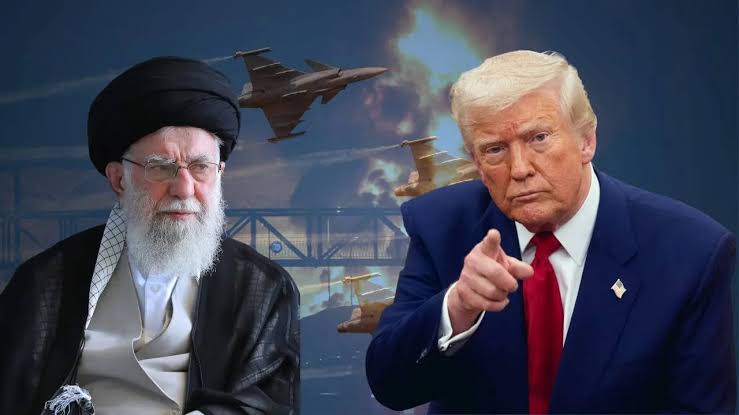
The violent protests that began in Iran on December 28, 2025, have subsided. International phone calls have been restored, and according to Iranian media, no incidents of unrest have been reported over the past 48 hours. However, on the other hand, threats from US President Donald Trump show no signs of stopping; instead, they appear to be intensifying with each passing day.
Although the situation in Iran appears to have returned to normal, the threat of a US military strike has not completely disappeared. The British broadcaster NBC has warned that the United States could target more than 50 locations inside Iran, while the British news agency Reuters reports that President Trump wants to carry out a short but forceful strike against Iran.
It has been a year since Donald Trump returned to power for a second term, but since re-entering the White House, his foreign policy has remained difficult to comprehend. At times, he speaks of peace and expresses his desire for a Nobel Peace Prize, while at other times, he openly talks about attacking other countries.
With the beginning of 2026, President Trump appeared in a new and more aggressive form. On January 2, he hinted at regime change in Iran. On January 3, he launched an attack on Venezuela, abducting its President Nicolás Maduro along with his wife. The very next day, he threatened to acquire Greenland. This raises the question: What exactly is Trump planning to do in 2026?
After Venezuela, will Iran be the next target, or are these merely threats? What would an attack on Iran—and a subsequent regime change—mean for Pakistan? In this regard, TNN spoke to experts on international affairs.
Iran Is Not Venezuela:
According to Mushahid Hussain Syed, head of the Pakistan-China Institute and former senator, President Trump feels more confident after what happened in Venezuela because he managed to get away with it. Without implementing regime change, Trump succeeded in arresting the Venezuelan president and his family, allegedly with the cooperation of a segment of Venezuela’s leadership.
However, Mushahid Hussain believes this strategy will prove harmful in the long run because Iran is not Venezuela. He also warns that the Greenland issue will have serious implications for the Western alliance, NATO, and US-European relations.
Trump Wants to Introduce a New World Order:
Senior journalist and international affairs expert Kamran Yousaf believes it appears that Trump wants to establish a new world order. Through such actions, Trump aims to send a message that the United States remains the world’s only superpower. Based on the way Trump handled Venezuela, there is a possibility that he could go to any extent to seize Greenland.
Trump Wants to Control the World Unilaterally:
Dr. Murad Ali, Professor of International Relations at the University of Malakand, says that globally, Trump is seen as an extremely unpredictable leader, and no one knows what his next move will be.
He pointed out that US policy traditionally involved adopting a soft approach with those who understand diplomacy and a hard approach with those who respond to force. However, under Trump, there is no softness—only rigidity.
Dr. Murad stated:
“President Trump is pursuing a policy of unilateral global control, which is an extremely dangerous approach. His recent actions signal that the era of soft diplomacy is over, and everything will now be achieved through force, as seen in the case of Venezuela.”
What Role Can Pakistan Play in Reducing Iran–US Tensions?
Mushahid Hussain Syed claims that Pakistan can play an important and effective role in reducing Iran–US tensions because Pakistan is a key stakeholder in the region. According to him:
“Two countries—Pakistan and Saudi Arabia—and two personalities—Pakistan’s Field Marshal Asim Munir and Saudi Prime Minister Mohammed bin Salman—can help resolve this conflict because both countries and individuals are close to and acceptable to both the US and Iran.”
Kamran Yousaf claims that during the Iran–Israel war last June, in which the US was also involved, it was believed that Pakistan played a role in easing tensions between Tehran and Washington.
Pakistan understands that instability in Iran will directly affect it; therefore, Pakistan wants the situation in Iran to avoid further deterioration. Given the current circumstances, it would not be surprising if Pakistan is playing a behind-the-scenes role in reducing US-Iran tensions.
However, Professor Dr. Murad Ali believes that this is Iran’s internal matter, and Pakistan cannot go beyond a certain limit. Pakistan is not a global power but a middle regional power, with a limited role that may extend only to back-channel diplomacy.
What Would Regime Change in Iran Mean for Pakistan?
Mushahid Hussain Syed believes Pakistan should strongly oppose any regime change in Iran, as it would be extremely damaging to Pakistan’s national security and national interests.
He presents three arguments to support his stance:
First, regime change in Iran would effectively bring Israel’s border to Taftan, because any new government in Iran would be pro-Israel and closely aligned with India. For Pakistan, it is unacceptable to have Israel, India, and Afghanistan simultaneously present along its borders.
Second, such a regime change would pose a serious threat to Pakistan’s federation, particularly in the context of Balochistan, as a pro-Israel government would attempt to destabilize Pakistan through the region.
Third, regime change would alter the regional balance of power. It would not be peaceful but would create instability, uncertainty, volatility, and increased violence in the region—consequences that Pakistan would be forced to endure.
Kamran Yousaf believes that a change in Iran’s current government would negatively affect Pakistan by creating uncertainty. Pakistan already has strained relations with Afghanistan and India, and a change of government in Iran would further compound these problems.
If a government aligned with Israel were to take power in Iran, the situation in Balochistan would deteriorate further.
Dr. Murad Ali believes that regime change in Iran would create difficulties for Pakistan, just as regime change in Afghanistan has already done. With strained relations with India, increased tension along what is currently a relatively stable Pakistan-Iran border would pose serious challenges.
He explains that if a pro-Israel or pro-US government comes to power in Iran, Pakistan’s problems will increase, especially given the already fragile situation in Balochistan. According to Dr. Murad, the only possible long-term benefit could be economic—if stability returns to Iran and sanctions are lifted, Pakistan might gain trade advantages—but the likelihood of this scenario appears extremely low.
.jpeg)

Comments
No comments yet. Be the first 🙂