


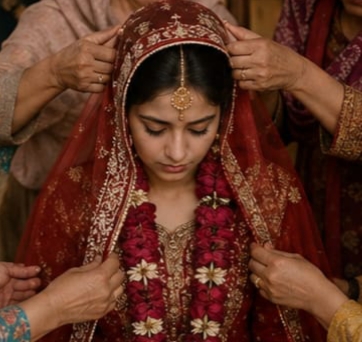
Twenty-four-year-old Sabahat sits quietly by the window, gazing outside. Her thoughts seem lost somewhere deep in the past.
She remembers her eighth-grade classroom, where she consistently secured second position. Her teachers often told her that if she continued working hard, she would one day become a doctor. But life took an unexpected turn that changed the direction of her dreams.
Today, she is responsible for running a household and is the mother of three daughters. She is living a life where responsibilities moved ahead while dreams were left behind. Hidden within her silence is a lingering question: Do dreams truly end before their time, or do they simply change their path?
Child marriage remains a significant social issue across the world. According to UNICEF, nearly one in every five girls globally is married before the age of 18, while approximately 40 percent of women worldwide were married during childhood.
Statistics show that the highest rate of child marriage is found in Nigeria, where nearly 70 percent of girls are married before reaching 18 years of age.
Pakistan is also affected by this issue. According to available data, around 18 percent of girls in the country are married before the age of 18. Experts believe that the effects of child marriage extend far beyond the individual, influencing education, health, economic opportunities, mental development, and overall social progress. In many cases, it disrupts education, increases the risks associated with adolescent pregnancy, and limits future opportunities.
Behind these statistics lie countless stories of childhood dreams that were altered by responsibilities that arrived too soon.
Also Read : Are We Eating Ourselves Sick? The Hidden Cost of Modern Food Habits
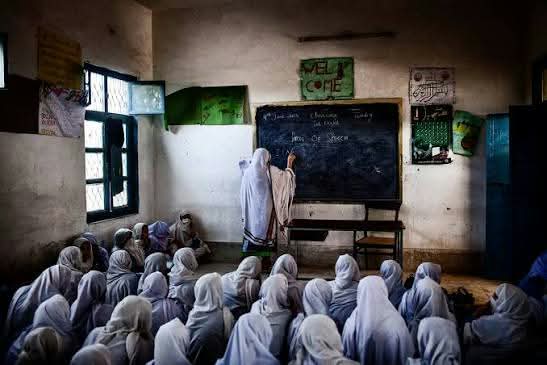
Sabahat, a 24-year-old woman from Swat, is one such example. She was married at the age of 15 while she was still an eighth-grade student and deeply passionate about her education.
“I loved studying,” she says. “I was in eighth grade and always stood second in my class. My dream was to become a doctor. At the time of my marriage, my parents made it a condition that I would be allowed to continue my education. My in-laws supported me and helped me complete my matriculation.”
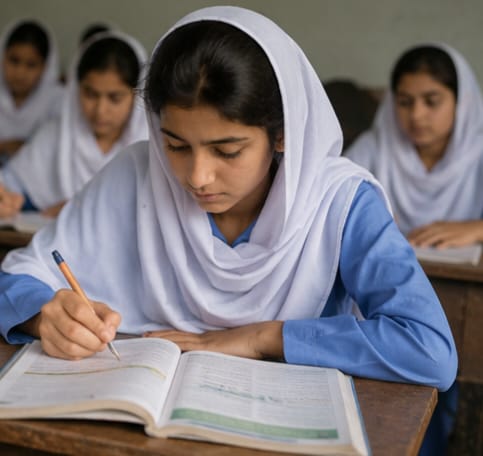
She explains that she tried to continue her studies after marriage, but the responsibilities of motherhood eventually interrupted her educational journey.
“My in-laws were very supportive regarding education,” she says. “But my children would cry a lot without me and were often ill, so after matriculation I had to stop studying.”
According to Sabahat, one of the biggest challenges of early marriage is adjusting to new responsibilities at a very young age.
“After marriage, you move into a completely new household,” she explains. “It takes time to understand and adapt to that environment. Childhood ends and responsibilities begin. It has been nine years since my marriage, yet there are still situations where I struggle to decide what the right course of action is.”
She adds, “I wanted to become a doctor. When I see my friends who are still studying or have achieved their dreams, I often wonder if I too could have fulfilled my dream had I been able to continue my education.”
Health Risks of Early Marriage:
Experts emphasize that the consequences of child marriage are not limited to education; they also involve serious health concerns.
Dr. Shaheen, a gynecologist from Karachi, says that early marriage and pregnancy can negatively affect a girl’s physical health because her body may not have fully developed.
“Young girls are more likely to suffer from anemia, malnutrition, weak bones, and complications during childbirth,” she explains.
According to Dr. Shaheen, adolescent girls face greater medical risks during pregnancy and childbirth because their reproductive systems and overall physical development are still incomplete.
“In cases of teenage pregnancy, the risks of premature birth, low birth weight, and various childbirth complications increase significantly,” she says.
She further notes that international health organizations continue to emphasize awareness regarding child marriage and adolescent pregnancy. According to the World Health Organization, complications related to pregnancy and childbirth are among the leading causes of death for girls aged 15 to 19 worldwide.
Psychological and Emotional Impact
Experts also highlight the psychological and emotional effects of child marriage.
Sarah Khan, a psychologist from Swat, says that child marriage can have profound consequences on a child’s mental and emotional development.
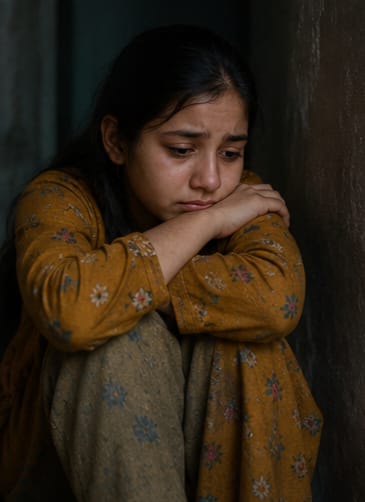
“At this age, children are still developing their personalities, thought processes, and emotional maturity,” she explains. “Marriage at such a young age often places them under psychological pressure, emotional confusion, and the burden of responsibilities they may not be prepared to handle.”
She adds that research indicates higher rates of stress, anxiety, and depression among children and adolescents who marry at an early age.
Islamic Perspective:
According to Islamic scholars, marriage in Islam is intended to establish a stable and lasting relationship based on peace, compassion, protection, and responsibility.
Dr. Ziauddin, an Islamic studies researcher from Swat, explains that the core objectives of marriage in Islam include mutual tranquility, mercy, and the formation of a strong family.
“Islamic teachings view marriage as much more than a social or family arrangement,” he says. “It is an important bond between two individuals, and therefore the consent of both parties is essential.”
Dr. Ziauddin notes that the Quran not only refers to physical maturity but also to rushd—mental and practical maturity. According to him, physical puberty alone is not sufficient; individuals should also possess the ability to understand and fulfill the rights, responsibilities, and obligations of married life.
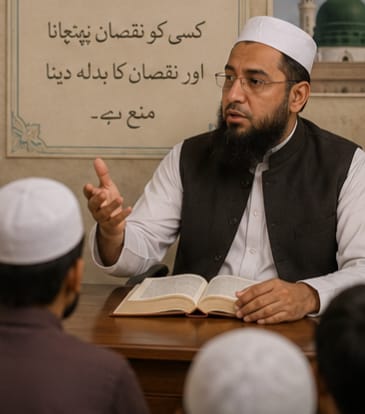
“If a boy or girl lacks the age, mental maturity, or physical capacity required to understand and manage marital responsibilities, the fundamental objectives of marriage—such as peace, affection, cooperation, and family stability—cannot be fully achieved,” he says.
He further emphasizes that genuine consent is only meaningful when an individual has the understanding and awareness necessary to make an informed decision.
“A young child may not fully comprehend the nature of marriage, its consequences, and the responsibilities it entails. That is why many scholars place great importance on informed and meaningful consent.”
Dr. Ziauddin also refers to the well-known Islamic principle La Darar wa La Dirar (“Neither inflict harm nor suffer harm”).
“If child marriage poses risks to physical, mental, educational, or social well-being, Islamic principles require measures to prevent such harm, because Islam prioritizes the protection of human life, intellect, dignity, and future prospects,” he explains.
He argues that credible scientific and medical evidence regarding the negative consequences of child marriage should be taken into consideration in legal and religious deliberations, as one of the fundamental objectives of Islamic law is the promotion of human welfare and the prevention of harm.
According to him, child marriage laws cannot simply be dismissed as un-Islamic because Islamic teachings associate marriage not only with puberty but also with maturity and the capacity to shoulder marital responsibilities.
“Islam does not prescribe a universal numerical age for marriage,” he says. “However, it emphasizes maturity, public welfare, and protection from harm. This is why many Muslim-majority countries have enacted minimum-age marriage laws to safeguard children’s education, health, and overall well-being.”
Legal Framework in Pakistan:
The legal status of child marriage is another important aspect of the issue.
Advocate Malik Saddam Hussain of the Peshawar High Court explains that laws aimed at preventing child marriage are designed to protect children's rights, education, health, and dignity.
“Child marriage can deprive children of education, expose them to health risks, and limit their future opportunities,” he says. “These laws seek to shield children from such social and economic challenges.”
According to Malik Saddam Hussain, Pakistan has different legal provisions regarding child marriage. In Khyber Pakhtunkhwa, the Child Marriage Restraint Act of 1929 is currently in force, setting the minimum marriage age at 18 for boys and 16 for girls. In Sindh and Islamabad, however, the minimum age is 18 for both boys and girls.
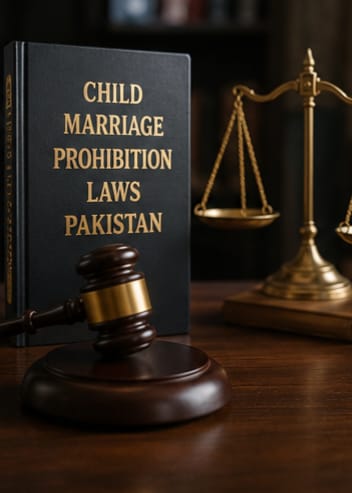
He explains that legal action may be taken against parents, guardians, marriage registrars, religious officiants, or anyone involved in arranging a child marriage, and penalties may include fines or imprisonment.
Malik Saddam Hussain further notes that child marriage laws are closely linked to constitutional rights.
“The Constitution of Pakistan recognizes the right to life, human dignity, equality, education, and the protection of children. In this context, laws preventing child marriage are viewed as an important mechanism for safeguarding children’s rights,” he says.
While differing legal and religious opinions continue to exist on the issue, there is broad agreement on one point: the health, education, dignity, and future well-being of children must be protected under all circumstances.
.jpeg)
.png)
1.jpeg)

Comments
No comments yet. Be the first 🙂