


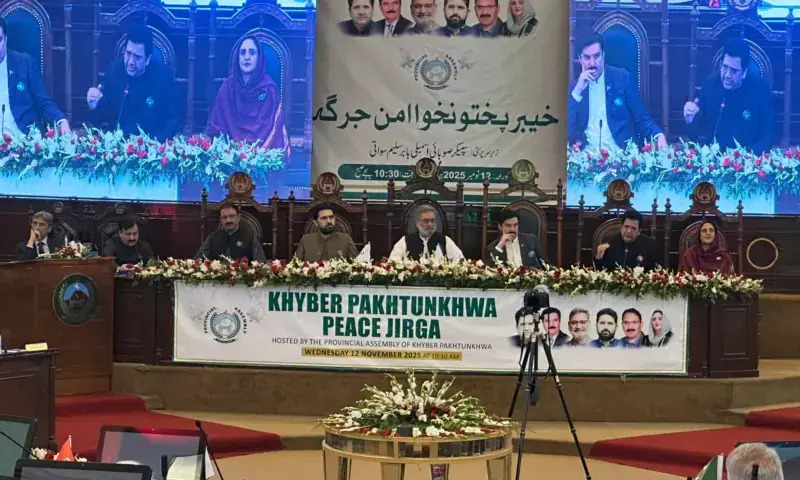
A historic “Khyber Pakhtunkhwa Peace Jirga” was held at the KP Assembly on Tuesday amid growing concerns over the province’s deteriorating law and order situation and a recent surge in terrorist attacks. The jirga brought together representatives from all political parties, religious scholars, social leaders, lawyers, and members of various schools of thought in a rare display of unity.
The session was chaired by Speaker Babar Saleem Swati, while Chief Minister Muhammad Sohail Afridi, Governor Faisal Karim Kundi, Opposition Leader Abadullah Khan of the PML-N, ANP’s Mian Iftikhar Hussain, former Jamaat-e-Islami chief Sirajul Haq, and delegations from JUI-F and Pakhtunkhwa Milli Awami Party were among the prominent attendees.
Welcoming the participants, Chief Minister Sohail Afridi expressed optimism that the jirga would pave the way for a lasting solution to terrorism. “Unfortunately, there are some elements who cannot tolerate peace,” he said.
Also Read: Sharp Rise in Dog Bite Cases Across KP Sparks Public Health Alarm
Speaker Babar Saleem Swati raised a key concern, saying, “Although our brave armed forces are defending the country, the question remains, why has sustainable peace not been achieved despite continuous intelligence-based operations?”
PPP leader Ahmed Karim Kundi lauded the initiative, terming it a landmark move. “For the first time, all political forces have been brought together on a single platform to formulate a collective plan for peace,” he said.
PTI leader and former National Assembly Speaker Asad Qaiser echoed the sentiment of unity, stating, “Peace is more important than politics. The participation of all parties here proves we stand united against terrorism.” He stressed the need to resolve tensions along the Pakistan-Afghanistan border through diplomatic means, adding, “Peace in Pakistan is not possible without peace in Afghanistan.”
PML-N Opposition Leader Abadullah Khan said, “We have set aside our political differences for one purpose—peace. Terrorism remains our biggest challenge. There can be no dialogue with those who slaughtered our children; they deserve no forgiveness.”
The jirga comes at a time when Pakistan faces a fresh wave of terrorist incidents. Just a day earlier, a suicide bombing near Islamabad’s G-11 District Courts claimed 12 lives, while an attack on the Cadet College in South Waziristan’s Wana left three people dead.
Political leaders concluded the jirga with a joint commitment that “decisions regarding peace will be made within representative institutions” and that all parties will work together to develop a unified strategy to eliminate terrorism from the region.

.jpg)
Comments
No comments yet. Be the first 🙂