


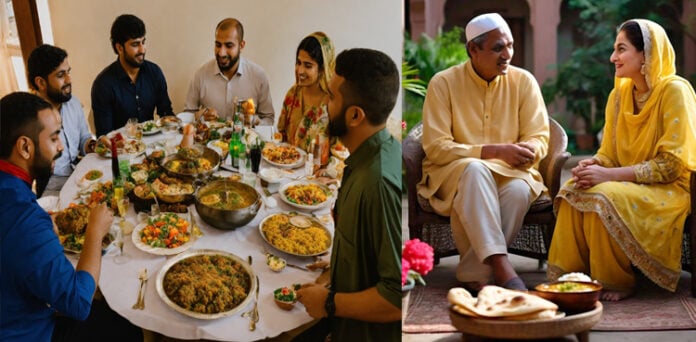
Joint family (shared family system) in Pakistan has for centuries been an important part of our social and cultural traditions. It is considered a symbol of love, unity, cooperation, and mutual dependence.
In one household, parents, siblings, sisters-in-law, children, and other relatives live together, share their joys and sorrows, and support each other in times of need.
On the surface, this system appears beautiful and strong, but over time, several aspects have emerged that require serious reflection.
Like any system, the joint family system is not perfect. It has both strengths and weaknesses. The problem arises when weaknesses are tolerated silently instead of being discussed.
In our society, women often do not express their problems for fear of disturbing the household environment or being misunderstood.
Also Read : Children in a Time-Scarce World: The Forgotten Need for Presence and Attention
This is especially true for women whose husbands work abroad. On the surface, people say she is not alone because her in-laws are with her, but the reality is often different.
Such a woman often feels mentally isolated. She has to play the role of both mother and father for her children, while her freedom in household decisions remains limited. Where to go, what to buy, what to cook, and what is best for the children—these decisions are often not hers alone.
Sometimes, even buying something for her own children with her own money requires justification.
These may seem like small issues, but over time they affect a woman’s mental peace, confidence, and personality. If she speaks up, she is seen as someone disturbing the household; if she remains silent, she continues to suffer internally.
Another important aspect of the joint family system is the sacrifices made by one family member.
In our society, this responsibility is often placed on the eldest son, although in some families it can fall on any one individual. He puts aside his education, dreams, and desires to fulfill family needs. The education and marriages of siblings, care of parents, and household expenses all fall on his shoulders.
However, unfortunately, when that same person reaches old age, illness, or weakness, those very people for whom he sacrificed his youth and earnings often distance themselves from him.
A few days ago, a girl contacted me. She wanted guidance on starting online work because she wanted to earn to continue her education. During the conversation, she shared a painful aspect of her life that was deeply heartbreaking.
She said her father spent his entire life making sacrifices for his siblings, fulfilling their needs, and supporting them in difficult times. But now, in his illness and weakness, no one stands by him. Even she had to take a loan to continue her education.
This situation not only brings sadness but also creates a deep sense of deprivation.
A very important question arises: why does the person who becomes everyone’s support end up being unsupported in his own difficult times?
Another major flaw in this system is the lack of financial planning. People often spend all their earnings on the family and save nothing for their future, illness, old age, or children’s education. As a result, the greatest burden later falls on their own wife and children.
Children are also affected by this system. When they see their father is always available for everyone else but has little time and attention for them, they develop a sense of deprivation. The woman, who manages the entire household, often sacrifices her own identity, desires, and mental health.
The reality is that the joint family system is not inherently bad. If there is justice, respect, boundaries, and fair distribution of responsibilities, it can be an excellent system. But when the burden is placed on one person and others only benefit, it becomes a burden rather than a blessing.
We do not need to end the joint family system, but to improve it.
A system where a woman’s voice is heard, her decisions are respected, responsibilities are shared fairly, and sacrifice is seen not as an obligation but as a value. Because relationships are not just about living together, but about standing with each other. Without justice, even love turns into silent suffering.
Note: This writing is based on the personal opinion of the author, and the institution does not necessarily agree with it.
.jpeg)
.png)
1.jpeg)



1 Comments
Very thought provoking article. In the past, the joint family system meant that younger siblings also take responsibility for the joint family system once they start earning. and, they are expected to support and guide and take care of the children of the elder brother. The second part of the understanding/unwritten arrangement in joint family system has disappeared and the first part continues to survive.